
Picture a Monday management meeting. The sales director reports quarterly revenue at 14.2 million. Finance has 13.6. The regional lead has a third number from a spreadsheet updated “last week, I think”. Someone asks the company’s new AI agent, and it confidently gives a fourth. The first twenty minutes go to arguing about which number is right. Nobody discusses what the number means or what to do about it.
The first twenty minutes go to arguing about which number is right. Nobody discusses what the number means or what to do about it.
Now replay the same meeting. Everyone, including the agent, gets the same number from the same governed definition of “revenue” that the finance reports use. The agent also knows the contract terms behind the two largest deals, who has been working on the stalled ones, and that a key competitor announced a price cut yesterday.
The meeting starts with the question that matters: what do we do next?
It’s the same AI model in both meetings. The difference is the context.
The question is changing
Enterprise AI discussions have circled around this question:
Which model should we use?
That question is quickly losing its weight. The leading models are available to everyone, often through the same platforms, and a new one arrives almost every month. Choosing a model still matters, but it is no longer a lasting advantage.
The question that matters now is:
What does our AI actually know about our business?
Microsoft states this very directly: your company’s IQ is the collective intelligence locked in documents, emails, meetings, operational data and the live web, and that is where the true competitive edge lives. A competitor can use the same model tomorrow. It can’t use your customer history, your contracts, your way of defining a “key account” or the knowledge in your people’s heads.
Models are everywhere. Your context isn’t.
That’s the idea behind Microsoft IQ.
Microsoft IQ
Microsoft IQ is described as the enterprise intelligence layer of the Microsoft stack. It gives Microsoft 365 Copilot and AI agents a shared, continuously updated understanding of the organization.
In practice, it brings together four kinds of knowledge that every organization already has but rarely connects:
- Work IQ – how people work, and how the business runs. Emails, meetings, chats, files, people and collaboration patterns, and now also business applications: records, relationships and processes from Dynamics 365 and Power Apps. Who is working on what, what was decided, what is top of mind, and where each customer, case or order stands.
- Fabric IQ – how the business is doing. Business data from Microsoft Fabric and Power BI, raised from tables and columns into the language of the business: customers, orders, shipments, assets, and the rules and metrics that connect them.
- Foundry IQ – what the organization knows. Policies, contracts, manuals, guidelines and other authoritative documents, organized as reusable knowledge bases that agents can draw on.
- Web IQ – what is happening outside. Fresh information from the web: news, pages, images and videos, so agents aren’t stuck at their training cutoff.
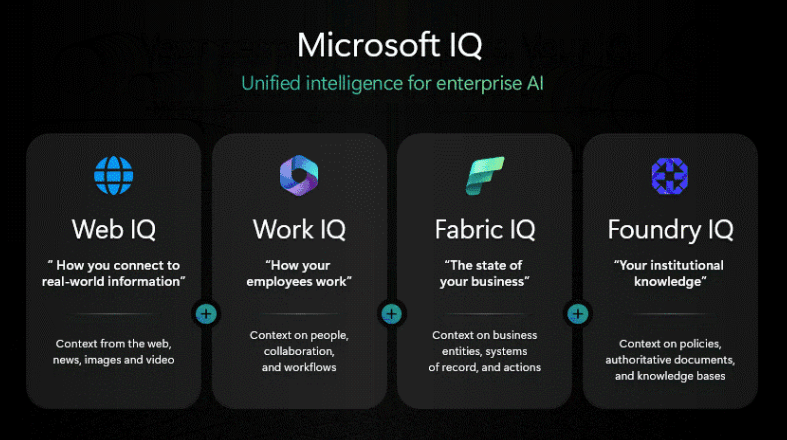
None of these is a single new product to buy. Together they describe how context reaches AI across the Microsoft stack. The good news is that most of the raw material is already there, sitting in Microsoft 365, Power BI, SharePoint and Fabric.
Microsoft now presents Microsoft IQ as one of three platform pillars: Copilot for people, Microsoft IQ for intelligence, and Agent 365 for trust and governance. In Microsoft’s words, it’s the platform to compound your intelligence from within while protecting what makes the business different.
What this means
Context becomes a strategic asset. The quality, structure and ownership of business knowledge now directly shape the quality of AI results. It’s no longer just “information management”. It’s a competitive factor. Microsoft’s recent research with Keystone across more than 200 enterprises points the same way: the companies furthest ahead build a shared “knowledge spine” that holds the context agents use and the lessons from their work, so fixing one agent’s mistake can improve the others. The SharePoint knowledge base, curated by Copilot on top of Work IQ, is an early example of such a spine at team level, as described in an earlier post, SharePoint Knowledge Base – Team Memory, Curated by AI.
Existing investments become AI investments. Power BI semantic models, SharePoint libraries and Microsoft 365 content all turn into fuel for AI. According to Microsoft, Power BI accounts for over 90% of semantic models in production, and those models can be used as the starting point for a business ontology.
Build once, reuse everywhere. Instead of every AI project building its own connection to the same data, knowledge can be organized once and shared across many agents. Fewer duplicate projects, faster delivery and more consistent answers.
Shared definitions become a leadership topic. When AI answers from “the” definition of revenue, customer or active project, someone has to decide what that definition is. That isn’t an IT decision. It’s a business decision.
Governance travels with the context. Permissions, sensitivity labels and access rules need to follow the knowledge wherever agents use it. Microsoft is building this into each layer, but it still has to be planned and owned.
What can already be done today
- Copilot answers business questions from governed Power BI data. Fabric IQ in Microsoft Copilot Chat and Cowork is generally available. Ask for the latest sales forecast, and the answer is grounded in the same semantic model that powers the organization’s reports. For Fabric and Power BI customers, this is on by default, respects existing access controls and comes without additional AI token costs. (Generally available, September 2026. Integration with the new Copilot Code experience is coming through the Frontier program.)
- Business data can be described in business terms. Fabric IQ itself is generally available, along with Operations Agents, which monitor live conditions against business rules and recommend or execute actions, and Graph for reasoning across relationships. The ontology, the shared model of business entities, relationships and rules, can be generated from existing Power BI semantic models in a few clicks. (Fabric IQ, Operations Agents and Graph generally available since June 2026. Ontology is in preview, with general availability planned for 2027.)
- Company knowledge can be organized once for many agents. Foundry IQ knowledge bases are generally available, with SLA coverage, compliance certifications and an MCP server that makes them usable from practically any agent platform. (Generally available since June 2026.)
- Copilot Studio agents can use the same knowledge. The Foundry IQ integration with Copilot Studio is generally available: one knowledge base can serve several Copilot Studio agents, with cited answers and support for private networking. (Generally available, October 2026.) Work IQ is also generally available in Copilot Studio, so low-code agents can draw on emails, meetings, files and business app context. (Generally available, November 2026.)
- One knowledge base can draw from the other IQs. New knowledge sources let a single Foundry IQ knowledge base reach into Work IQ, Fabric IQ (including data agents and ontologies), Azure SQL, uploaded files and MCP sources, with no custom integrations. (Preview.)
- Copilot and agents understand business applications. Business Applications in Work IQ bring records and processes from Dynamics 365 Sales, Dynamics 365 Customer Service and Power Apps into Copilot and agents, with reading, creating and updating records under user confirmation. More on this below. (Public preview since September 30, 2026. General availability for Power Apps model-driven apps planned for November 2026, Roadmap 571888.)
- Work context is available to any agent. The Work IQ API became generally available on June 16, 2026. It is licensed independently of Microsoft 365 Copilot and billed by usage in Copilot Credits, with no separate subscription or per-user licence, so custom and third-party agents can use the same work context Copilot uses. Data and tools from enterprise systems already connected to Copilot through Copilot connectors are also becoming available to agents through the Work IQ APIs, with no separate setup and with existing permissions and admin controls in place. (MC1538999, rolling out late November to late December 2026.) Agents will also be able to read a user’s own Copilot memory, such as custom instructions and saved memories, so their help is more personal. Access is read-only, follows each user’s personalization settings, and the admin policy is on by default. (MC1539004, rolling out December 2026.)
- Agents can search work content directly. The new Work IQ Retrieve tool lets agents search email, files, meetings, Teams messages and connected sources, returning cited content that respects each user’s permissions. (Public preview, October 2026.)
- Agents can follow meetings as they happen. Work IQ real-time transcripts give apps and agents access to Teams meeting transcripts while the meeting is still running, for live assistance and insights. (Roadmap 570651, preview since September 2026, general availability planned for November 2026.)
- Agents can work with SharePoint, not just read it. SharePoint tools in Work IQ give agents more than 60 SharePoint operations, from finding and organizing content to lists and approvals, with separate permissions for reading and for making changes. They are also rolling out to Copilot Studio. (Public preview, November 2026.)
- Agents can reach the outside world. Web IQ brings fresh web content to agents while honouring publisher preferences. It’s now open to all paid Azure accounts, with no waitlist and usage-based pricing, and it plugs into Foundry IQ as a knowledge source. (Available, November 2026.)
- Business context can be shared with partners. IQ Sharing in Fabric lets organizations share data, and the business meaning behind it, with customers and partners while keeping governance of the underlying assets. (Preview.)
So there is already a lot to work with. And that is not a full list – not by all means! That’s only covering what has come out recently.
Work IQ and business applications – the systems of record join in
Fabric IQ isn’t the only way business data reaches AI. With Business Applications in Work IQ, data and processes from Dynamics 365 Sales, Dynamics 365 Customer Service and Power Apps come into Copilot and agents, with Dynamics 365 Finance and Operations rolling out as well. The business applications stay the systems of record. What changes is that Copilot and agents can now understand them, together with emails, meetings and files.
Microsoft describes the idea in three parts:
- Model the business once. A shared semantic model tells every agent what the data means, how records relate and what the organization’s own terms mean. It builds on what already exists in the apps (views, forms and relationships) plus a business glossary, so context isn’t rebuilt agent by agent.
- Turn the playbook into business skills. How the organization works, such as which criteria matter and when approval is needed, is captured once as a reusable skill that any agent connected to Work IQ can follow, including agents built in Copilot Studio.
- Act with governance built in. Copilot and agents show the proposed changes, follow any required approval and update the records within the user’s own permissions, with Agent 365 providing oversight.
Microsoft’s own example is a customer renewal. The opportunity looks healthy in Dynamics 365 Sales. Dynamics 365 Customer Service, however, shows an unresolved equipment issue, and recent customer emails and a Teams meeting make clear that fixing it is a condition of renewal. No single app shows that picture. Work IQ connects it, and a renewal-readiness business skill turns it into concrete next steps.
A practical way to see the difference between the two routes for business data:
- Fabric IQ gives the agreed analytical and operational picture: the numbers, definitions, trends and relationships across the data estate.
- Business Applications in Work IQ bring the live records and processes themselves: this customer, this case, this order, the steps around them and the ability to update them.
Most organizations will need both. The first answers “how is the business doing?”, the second “what is happening with this customer, and what should happen next?”
The action side of this, and why permission to know isn’t permission to change, was covered in an earlier post, From Answers to Actions with Work IQ. In the Microsoft IQ picture, the same capability is what connects people’s work with the systems where the business actually runs.
Foundry IQ pulls the others together
Until now, many AI project has rebuilt the same foundation: connect to SharePoint or Azure AI Search (or some other central container with index), prepare the documents, set up search, add some business data from another system and maybe add web search on top. Every team solved the same problem again, and every solution handled permissions slightly differently.
Foundry IQ changes that pattern. An organization creates a knowledge base that holds the knowledge relevant to a domain, such as customer service, procurement or HR. That knowledge base can draw from documents and also from Work IQ, Fabric IQ and Web IQ. Any number of agents can then use the same knowledge base, whether they’re built in Copilot Studio, Microsoft Foundry or another platform.
Behind the scenes, Foundry IQ works out how to answer. It breaks a complex question into smaller ones, searches the relevant sources in parallel and returns a grounded answer with citations. Microsoft reports that this approach improved recall by up to 54% compared to simple single-shot retrieval.
Three things make this especially interesting from a business angle:
- Reuse. A well-built procurement knowledge base can serve a procurement assistant, a contract review agent and a supplier risk agent at the same time.
- Security at the data layer. Document-level permissions are respected, and new preview capabilities extend this to Microsoft Purview sensitivity labels and SharePoint permission sync. Agents should only see what the person using them is allowed to see.
- Openness. Through the Foundry IQ MCP server, the same knowledge can serve agents built on many frameworks, not only Microsoft’s. That protects the investment if the agent landscape changes, which it will.
One knowledge base, many agents. That’s where the “build once, reuse everywhere” promise becomes real.
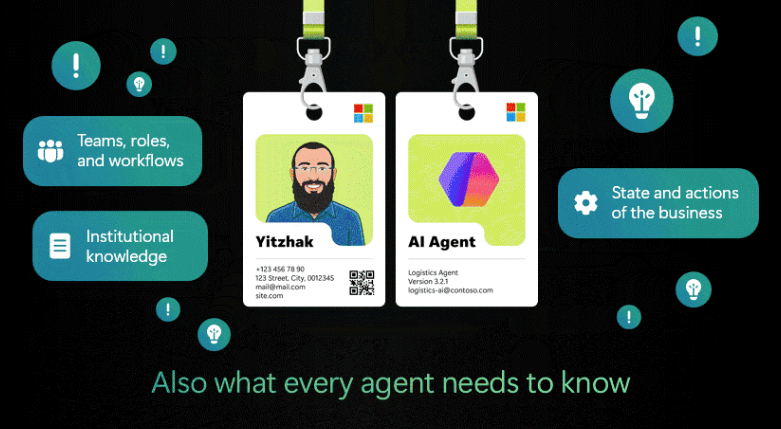
Same question, four layers
Here is a scenario that shows the difference.
A key supplier is delivering late. A procurement manager asks an agent: “Which supplier delays should we escalate this week, and why?”
- Fabric IQ knows the business situation: which deliveries are late, which customer orders they affect and how much revenue is at risk. Because of the ontology, the agent can follow the chain from supplier to component to order to customer.
- Foundry IQ retrieves the supplier contracts and finds the delivery terms and penalty clauses that apply.
- Work IQ shows who has already been in contact with the supplier, what was agreed in last week’s meeting and which account managers are getting questions from customers. Through business applications, it also brings in the open supplier and customer cases from the CRM.
- Web IQ adds that the supplier’s main factory region has been hit by a port strike, according to this morning’s news.
The answer isn’t just a list of late deliveries. It’s a recommendation: escalate these two, here is the contract clause to refer to, these are the people already involved, and this is likely to get worse before it gets better.
Without the shared context, the same answer would take a few people half a day of emails, spreadsheets and phone calls.
This isn’t only a thought experiment. Microsoft shares customer examples that point the same way (results as reported by Microsoft):
- Rockwell Automation built a maintenance assistant on Microsoft Foundry that brings together veteran engineers’ expertise, manufacturing data and machine manuals. At its Singapore factory, machine downtime fell by 33%, and the time for new workers to learn troubleshooting dropped from nine months to three.
- BNY runs more than 300 solutions on its in-house AI platform, built with Azure, Microsoft Foundry, Copilot and GitHub Copilot, and plans to add Work IQ. Client transaction inquiries are resolved 80% faster.
In both cases, the advantage comes from the organization’s own knowledge, not from the model.
Things to plan for
The direction is promising, but a few things deserve attention before the context layer is switched on broadly.
Context quality is the new data quality. AI built on outdated documents, duplicate versions and unclear definitions will give outdated and unclear answers, just faster and with more confidence. Content ownership and life cycle aren’t glamorous topics, but they now directly affect AI results.Your data needs to be in order for quality context!
Ontologies are a business modeling exercise. Generating an ontology from Power BI models should be done. Agreeing on what “customer”, “active contract” or “at-risk order” means across business units isn’t. That conversation needs business owners, not just data engineers.
Business data comes with layered controls. Admin controls for business applications in Work IQ (MC1518036, preview from mid-November) split the decision across three roles. AI admins switch it on, platform admins choose which environments take part, and app makers pick the individual apps and data. Each of those roles needs an owner before Copilot and agents start reasoning over CRM and business app data.
Usage-based costs need watching. Several of these capabilities, such as the Work IQ APIs for custom agents and Foundry IQ Serverless, are billed by usage. Billing for Foundry IQ Serverless began on September 13, 2026. Agents that run often and widely can add up, so cost visibility belongs in the plan from day one. The Microsoft 365 admin center now previews central Copilot Credit cost management, including the Work IQ APIs, with spending limits and alerts. See also AI FinOps for Microsoft Copilot – a guide to Cost Management and the Cost Management API
Internal and external context are different things. Web IQ brings the outside world in, and that is valuable. It also means being clear about which answers rely on internal, governed knowledge and which rely on the public web. The same care applies inside the Microsoft stack: connecting Work IQ to a Foundry IQ knowledge base can add costs, and Microsoft notes that data may be processed outside the Azure compliance boundary, so compliance teams should review it first.
Preview is preview. Some of the most interesting pieces, such as ontologies, multi-source knowledge bases and IQ Sharing, are still in preview. The ontology is planned to reach general availability in 2027. Until then, these are good for pilots and learning, but production plans should follow the release status.
Where to start
The easiest way in is not a technology project. It’s a business question.
Pick one question that leadership regularly argues about. Revenue, forecast, customer churn, delivery performance, whatever causes the “whose number is right?” discussion. Make sure the Power BI semantic model behind it is the agreed one, and check how Copilot answers it now that Fabric IQ is available in Copilot Chat and Cowork.
Pick one domain where knowledge is scattered. Procurement, HR policies, customer service or product documentation. Organize it as one Foundry IQ knowledge base and let two or three agents reuse it.
Name owners for context. Someone needs to own the definitions, the knowledge bases and the content behind them, just as someone owns the processes.
Connect it to action carefully. Context is what makes agents useful, and useful agents will soon be asked to act. The question of what AI is allowed to change follows naturally from what AI knows. Those two discussions belong together.
From knowing more to knowing better
During recent years, enterprise AI has been a race for the best model. That race isn’t over, but it no longer decides the winner on its own.
What decides it now is how well AI understands this business: its people, its numbers, its knowledge and the world around it. Microsoft IQ is Microsoft’s answer to how that understanding gets built, shared and governed, and Foundry IQ is where much of it comes together.
Much of the foundation is already available, and more is on the way. Microsoft’s roadmap already lists a “Work IQ: Microsoft IQ” item, described as a unified intelligence layer that helps agents discover, reason over and use organizational knowledge, with a preview planned for November 2026. Microsoft has also said that Ignite (17–20 November 2026) will broaden the story further, so this is a good moment to get the basics in order before the next wave arrives.
This post continues a series on how Microsoft’s context layer is changing work. From Answers to Actions with Work IQ looked at what AI is allowed to change, and SharePoint Knowledge Base – Team Memory, Curated by AI at how AI writes down what a team knows. Microsoft IQ is the bigger frame around both.
Where does your organization stand? Is your AI working from your context yet, or still from generic knowledge?
Learn more
Status as of November 5, 2026. Preview features, roadmap dates and pricing can change.
Microsoft IQ and the four IQs
- Microsoft IQ – product overview
- Microsoft IQ documentation – Microsoft Learn hub, with what’s new for each IQ
- Work IQ overview – Microsoft Learn
- What is Fabric IQ? – Microsoft Learn
- Foundry IQ – product page, and What is Foundry IQ? on Microsoft Learn
- Web IQ – product page, and Web IQ documentation on Microsoft Learn
Recent announcements
- Introducing SharePoint tools in Work IQ – Microsoft SharePoint Blog, November 3, 2026
- New and improved: Agents that are persistent, agents for customer conversations, and improved maker experience in Microsoft Copilot Studio – Microsoft Copilot Blog, November 4, 2026
- The platform approach to becoming Frontier – Official Microsoft Blog, October 27, 2026
- The AI advantage your company can keep – Microsoft Copilot Blog, October 27, 2026
- AI that understands your business: Dataverse and Work IQ at PPCC 2026 – Microsoft Power Platform Blog, October 23, 2026
- Work IQ: the new retrieve tool – Microsoft 365 Developer Blog, October 20, 2026
- Foundry IQ in Microsoft Copilot Studio is now generally available – Microsoft Foundry Blog, October 1, 2026
- New Microsoft data innovations unlock what only your business knows – Official Microsoft Blog, September 28, 2026
- Work IQ: Business and workplace intelligence in the flow of work – Microsoft Dynamics 365 Blog, September 25, 2026
Message Center and roadmap
- MC1539004 – Work IQ expands memory capabilities to agents (published November 5, 2026)
- MC1538999 – Copilot connectors in Work IQ APIs (published November 5, 2026)
- MC1518036 – Admin controls to manage Business Applications in Work IQ (published October 20, 2026)
- Roadmap 570870 – Work IQ: Microsoft IQ
- Roadmap 570651 – Work IQ: Real Time Transcripts
- Roadmap 571888 – Power Apps model-driven applications in Business Apps in Work IQ
- Microsoft Fabric roadmap – IQ – ontology general availability and related items
Earlier posts in this series


