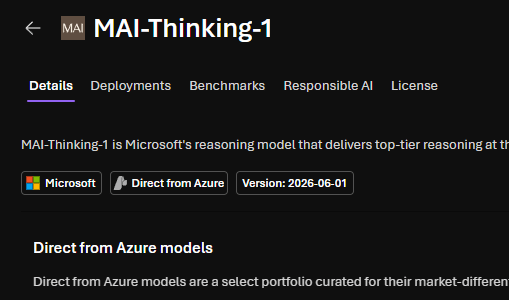
Microsoft AI just introduced MAI-Thinking-1, their first reasoning model – and it is already in the Microsoft Foundry model catalog in public preview. Announced August 12, 2026, this is MAI’s own reasoning model, trained from the ground up, not distilled from anyone else’s models.
And yes – I of course tested it out. I already deployed it to my own Microsoft Foundry, so let’s take a closer look at what it is and why it matters for Future Work.
- MAI-Thinking-1
- The benchmarks
- Clean data
- Pricing
- Direct from Azure – what that means
- Where I would actually use it
- Notes
- Verdict
MAI-Thinking-1
MAI-Thinking-1 is a reasoning model: you give it a prompt, and it produces an internal chain of thought before it answers. The interesting part is that it allocates the reasoning effort adaptively based on how complex your prompt is. Simple question, less thinking. Hard question, more thinking. That is exactly the kind of behavior you want when you are paying per token.
Under the hood it is a sparse Mixture-of-Experts (MoE) Transformer with 35B active and ~1T total parameters. MoE means only the parts of the model needed for each request get activated – capability scales up without compute scaling linearly with it. Microsoft calls it a medium-sized model that stands among the strongest in its weight class.
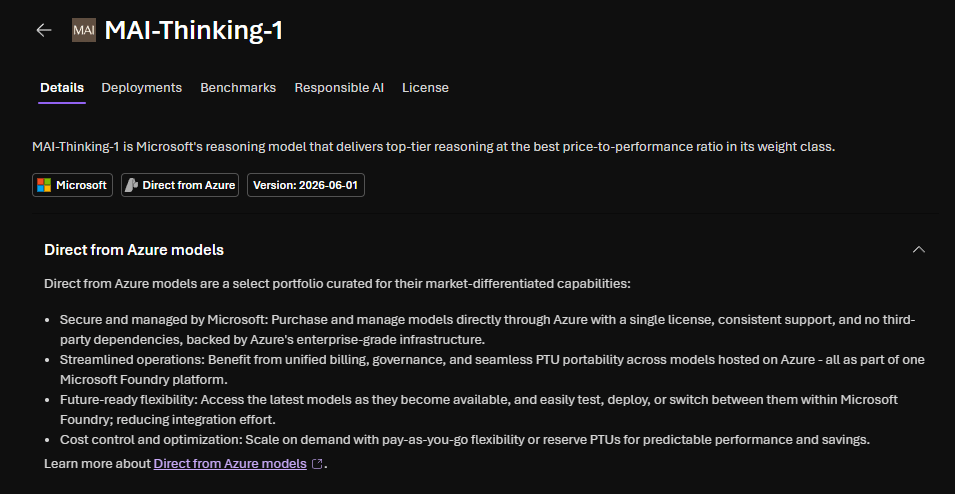
Some key numbers:
- 256K context window – Microsoft notes that is enough to fit a 600-page document
- Function calling and support for developer instructions
- Built on the widely used Chat Completions API, so migration is meant to be easy
- Training cut-off: July 2026
- Text-only – no image, audio or video in or out
Work is changing. And the models we build our agents on are changing even faster.
The benchmarks
Microsoft is not claiming this is the biggest model on the planet. They are claiming it is the best in its weight class, and the numbers they published back that framing up:
- 97.0% on AIME 2025 and 94.5% on AIME 2026 – serious mathematical reasoning
- Toe-to-toe with Claude Opus 4.6 on SWE-Bench Pro for agentic coding
- Preferred over Claude Sonnet 4.6 in a blind human side-by-side evaluation run with their partner Surge, spanning 1,276 tasks in single-turn and multi-turn conversations
That last one is the one I find most interesting. Benchmarks measure capability, but that human preference evaluation measures whether the model actually understands the task, follows the instructions, uses the right level of detail and respects your time. That is the stuff that decides whether people keep using an agent you built – or quietly go back to doing it by hand.
Clean data
This is the part I think enterprises should read twice. Microsoft trained MAI-Thinking-1 without distillation from third-party models, on data they describe as clean, traceable and enterprise-grade, appropriately licensed.
Why does that matter to you and me? Because provenance is becoming a governance question, not just a research one. When your legal, compliance or security people ask “what shaped this model?”, “we can account for it” is a very different answer than “it learned from another model that learned from something else”. Quality, provenance, control – that is the pitch, and it is a good one.
Microsoft frames this as part of their broader work towards Humanist Superintelligence: AI designed to serve people and organizations, not replace them. They also make a point I really like – that a model refusing legitimate requests under the guise of safety is a defect too, not a feature. They train unsafe compliance and unnecessary refusal as defects in the same reward system. Anyone who has ever been refused by an AI for asking something completely normal knows exactly why that matters!
Pricing
MAI-Thinking-1 is priced at $2 USD per 1M input tokens and $8 USD per 1M output tokens.
That is the whole bet, really: strong reasoning at a price-performance point that makes high-volume, always-on AI workloads economically viable. Because here is the thing about agents – the pilot is never the expensive part. The expensive part is when it works, everyone starts using it, and it runs all day every day across the organization. A reasoning model that is affordable enough to leave running is a different proposition than one you only bring out for special occasions.
Combine that with adaptive reasoning effort and you get a model that does not burn tokens thinking hard about easy questions. Smart, like really smart.
Direct from Azure – what that means
MAI-Thinking-1 is a Direct from Azure model in Microsoft Foundry. In practice:
- Secured and managed by Microsoft – single license, consistent support, no third-party dependencies
- Unified billing and governance, with PTU portability across models hosted on Azure
- Pay-as-you-go flexibility, or reserve PTUs when you want predictable performance and savings
- Test, deploy and switch between models inside one platform
It also plugs into Foundry’s integrated evaluation, observability, safety and deployment capabilities. If you are building agents for real production use, that surrounding toolset matters at least as much as the model itself.
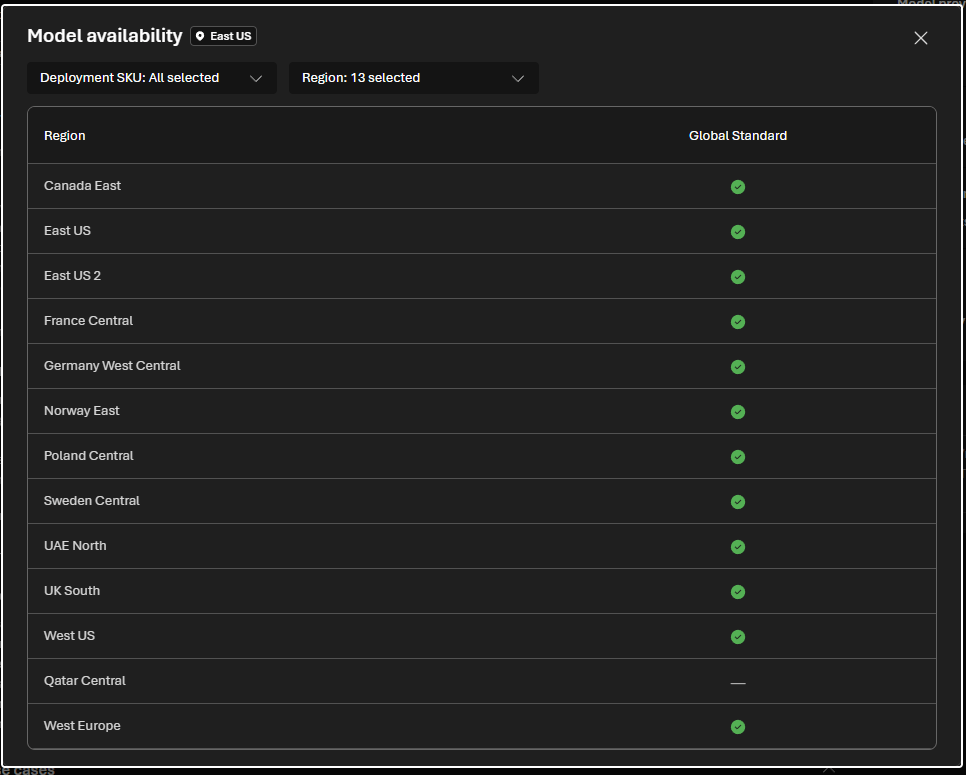
MAI-Thinking-1 is available on various other regions also, I could not screenshot them all at once so I selected some regions. The point: it is quite widely available, but there are some regions that don’t have it.
Where I would actually use it
Microsoft calls out three use case areas, and all three are very recognizable from real customer work:
- Enterprise deployments – 256K context, clean data provenance, function calling, complex instruction following
- Coding workflows – reading code, editing files, running tests, bug fixing, observing failures and recovering from intermediate mistakes
- Complex reasoning – especially quantitative work like financial modeling, statistical analysis, market sizing and forecasting
That 256K context window is the one I keep coming back to (although it is not 1M like with Claude..). Long agent traces without chunking and stitching them together is a genuine quality-of-life improvement when you are building multi-step agents. Anyone who has built a workflow that had to summarize its own history to survive knows the pain.
Notes
It is public preview, so treat it accordingly – this is for testing and building, not for betting your production workload on today.
A few more things worth knowing before you deploy:
- It is not designed as an autonomous decision-maker in consequential domains – legal, financial, medical, employment, educational, housing, credit, safety-critical. Not a substitute for professional advice in regulated fields.
- It has no native tool interface. Tool use is mediated entirely by your application, which means you own the security boundary around anything you expose to it. Please read that sentence again if you are building agents.
- It is not evaluated for fully autonomous agentic deployments acting on untrusted external content without human oversight or harness-level controls.
- Language coverage varies. It is primarily optimized for English, and also supports German, Spanish, French, Italian, Portuguese, Chinese (Simplified), Russian, Hindi, Japanese, Korean, Arabic and Hungarian, with more limited coverage for Hebrew, Turkish, Persian, Thai, Vietnamese, Indonesian and Ukrainian among others.
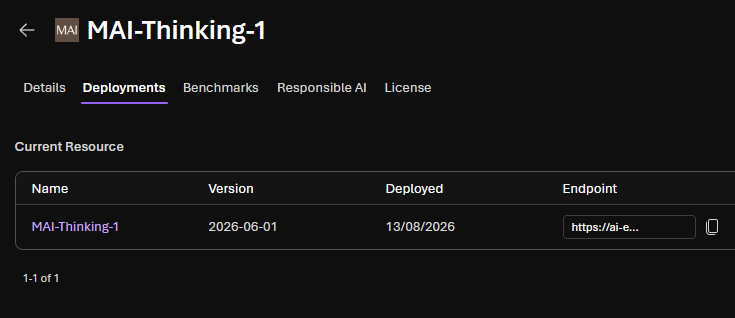
Try MAI-Thinking-1 in Microsoft Foundry Public Preview API and Playground are available. Deployment was genuinely easy – find it in the catalog, deploy, and you are testing in minutes. Setup could not be much simpler.
Verdict
MAI-Thinking-1 is not trying to be the biggest model in the room. It is trying to be the one you can actually afford to run all day – and that is a much more useful ambition for the kind of work most of us are doing right now. Strong reasoning, real agentic coding chops, a 256K window, clean and traceable data, and $2/$8 per million tokens.
For me the most exciting signal is not the benchmark table at all. It is that Microsoft is building its own reasoning capability from the ground up, on data it can account for, inside the same Foundry platform where the evaluation, observability and governance already live. That is a very different foundation to build enterprise agents on than we had even a year ago.
I am also waiting and hoping that this model will come to Copilot Cowork soon, as it will help to lower costs using Cowork!
Have you already deployed MAI-Thinking-1 in your own Foundry? I would like to hear what you are building with it – drop a comment and let me know!
Sources: Introducing MAI-Thinking-1 | Microsoft AI · MAI-Thinking-1 in the Microsoft Foundry model catalog

 Vesa Nopanen - Future Work today