Claude Opus 4.6, Anthropic’s most intelligent model to date, is now available in Microsoft Foundry. This is superb news, this it opens up new possibilities for production-grade AI agents and enterprise workflows that demand both frontier intelligence and enterprise-grade governance.
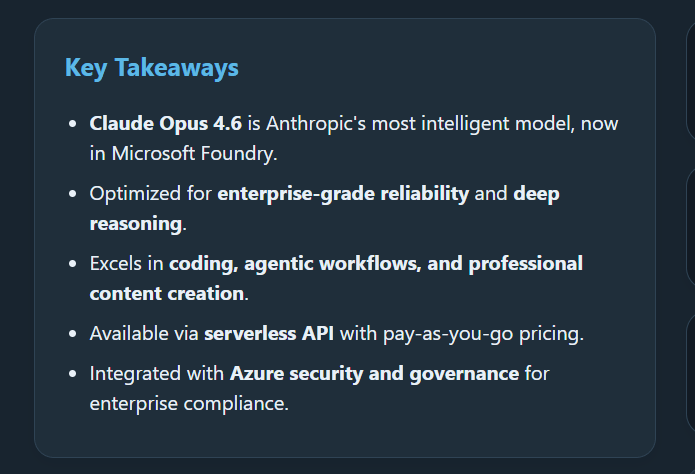
If you’re building AI solutions that need to handle complex coding, sophisticated agents, or high-stakes enterprise work, this is a meaningful step forward.
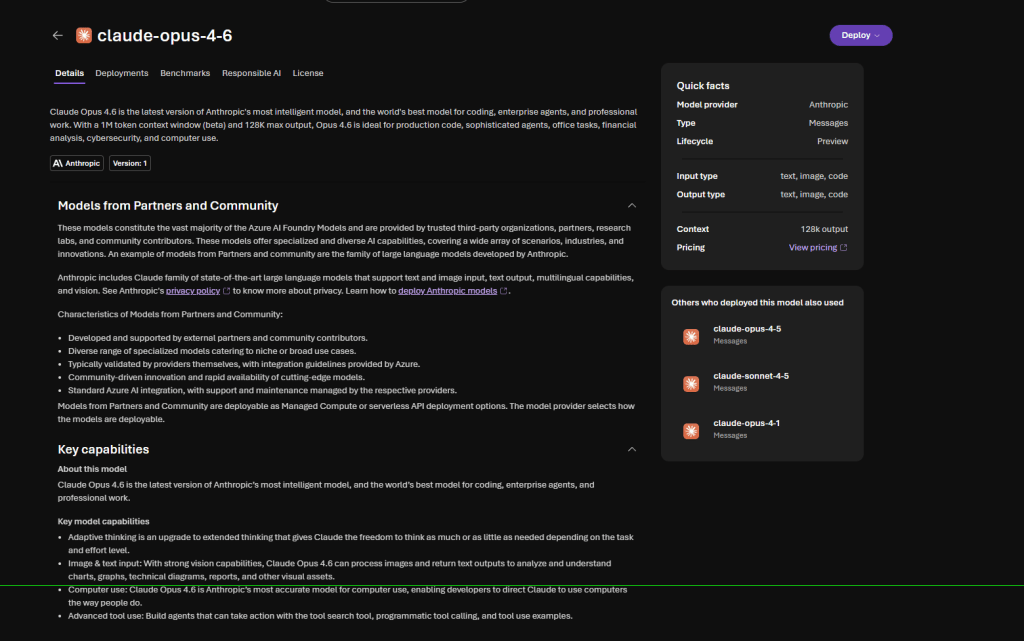
Key Facts About Claude Opus 4.6
Claude Opus 4.6 represents a genuine advancement in what AI systems can reliably accomplish. It’s not a general-purpose model trying to do everything—it’s optimized for specific scenarios where reliability and depth of reasoning matter most.
The model brings new levels of reliability and precision to the most demanding enterprise tasks, with state-of-the-art performance across coding, agents, and professional workflows.
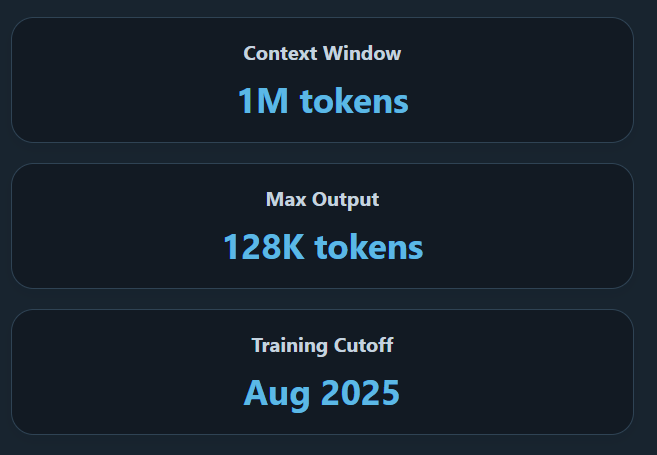
Key Capabilities That Set It Apart
1. Adaptive Thinking
The model dynamically decides when and how much to think based on task complexity, optimizing the balance between performance, latency, and cost. You can also manually control effort levels from low to max depending on your needs.
2. Production-Grade Coding
Opus 4.6 handles the full development lifecycle from architecture to deployment. It plans carefully, sustains effort across large codebases, and catches its own mistakes through improved code review and debugging skills. Senior engineers can delegate complex tasks with confidence.
3. Sophisticated Agents
This is the world’s best model for agentic workflows, orchestrating complex tasks across dozens of tools with industry-leading reliability. It proactively spins up sub-agents, parallelizes work, and drives tasks forward with minimal oversight.
In blind testing across 40 cybersecurity investigations, Claude Opus 4.6 produced the best results 38 out of 40 times compared to Claude 4.5 models.
4. Enterprise Workflows
Opus 4.6 sets the standard for enterprise workflows with professional polish and domain awareness. It excels at spreadsheets, slides, and documents—producing work that looks and reads like expert-created content.
5. Financial Analysis
The model surfaces insights that would take analysts days to compile, with the nuance and precision that compliance-sensitive work demands. When deployed through Microsoft Foundry, these workflows benefit from Azure’s security, compliance, and auditability.
6. Advanced Computer Use
Opus 4.6 is Anthropic’s most capable computer-use model, bringing deep reasoning to multi-step tasks that span multiple applications. It can interact with software, navigate interfaces, complete forms, and move data across applications—all running as secure, governed agents in Microsoft Foundry.
Deployment and Integration
Claude Opus 4.6 is available through serverless API or managed compute deployment options in Microsoft Foundry. The serverless API is particularly attractive for most enterprise scenarios with pay-as-you-go billing—you’re only charged for what you use.
Pricing (Token-Based)
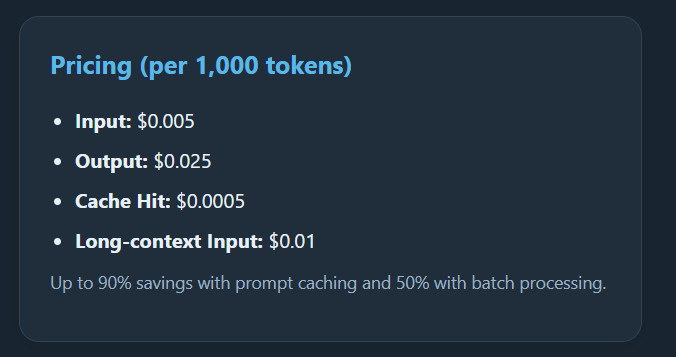
- Input tokens: $0.005 per 1,000 tokens
- Output tokens: $0.025 per 1,000 tokens
- Cache hit tokens: $0.0005 per 1,000 tokens
- Long-context input: $0.01 per 1,000 tokens
Anthropic offers up to 90% cost savings with prompt caching and 50% savings with batch processing, making it economically viable for large-scale deployments.
What Makes Foundry Deployment Powerful
The model integrates with Foundry IQ to access data from M365 Work IQ, Fabric IQ, and the web.
Key integration features:
- Advanced tool use: Build agents with tool search, programmatic tool calling, and examples
- Image & text input: Strong vision capabilities for charts, graphs, diagrams, and reports
- Multilingual support: Works across English, French, Arabic, Mandarin, Japanese, Korean, Spanish, Hindi, and more
- Azure security: Private networking, content filtering, and key-less authentication
Security and Data Handling
When you deploy Claude Opus 4.6 through Microsoft Foundry, your data stays within Microsoft’s infrastructure. Microsoft does not use your inputs or outputs to train models, and Anthropic does not have access to your data when the model is deployed in Azure.
Customer data may be processed in select regions but is only stored in US data centers. You benefit from:
- Azure’s enterprise-grade security, compliance, and auditability
- Private networking support
- Content filtering capabilities
- Enterprise governance and access controls
Use Cases Summary
| Scenario | Why Opus 4.6 Excels |
|---|---|
| Production Code | Handles full lifecycle from architecture to deployment with sustained effort across large codebases |
| Sophisticated Agents | Industry-leading reliability for orchestrating complex tasks across dozens of tools |
| Office Tasks | Professional polish for spreadsheets, slides, and documents with domain awareness |
| Financial Analysis | Surfaces insights requiring days of analyst work with compliance-level precision |
| Cybersecurity | Deep reasoning for identifying subtle patterns and complex attack vectors |
| Computer Use | Most capable model for complex workflows across multiple applications |
The Bottom Line
The availability of Claude Opus 4.6 in Microsoft Foundry represents a genuine step forward for enterprise AI. This isn’t about incremental improvements—it’s about opening up scenarios that weren’t previously possible with the required level of reliability and governance.
For organizations building AI agents, working with production code, or deploying sophisticated workflows, this model offers a new benchmark in what’s achievable. The combination of Anthropic’s frontier intelligence with Microsoft Foundry’s enterprise infrastructure creates a compelling platform for deploying AI at scale.
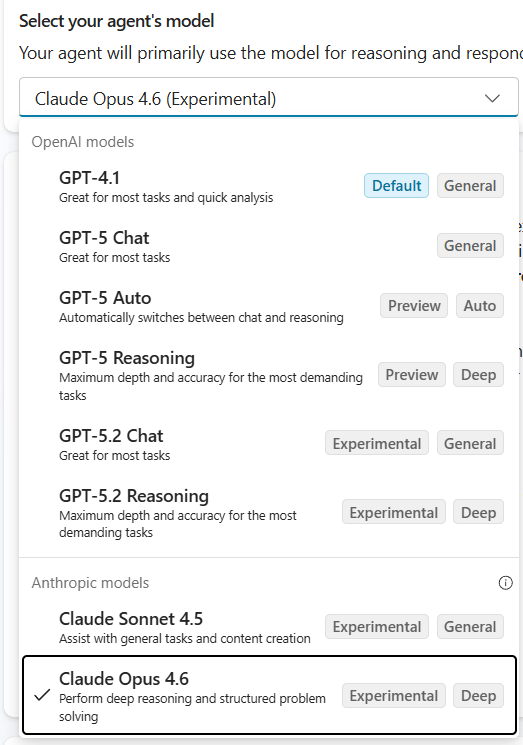
Ready to explore? You can start working with Claude Opus 4.6 in Microsoft Foundry and in Copilot Studio today.

 Vesa Nopanen - Future Work today